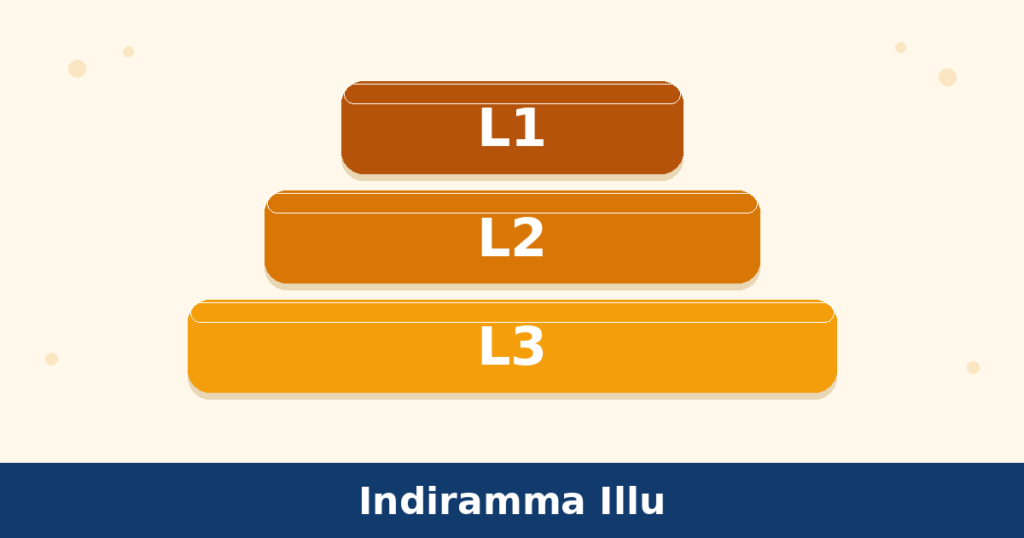
If you searched for indiramma illu l1 l2 l3, you want one answer: what the List1, List2 or List3 label on your result means. It is not a queue number or the order lists were published. It is a category fixed during the field survey, based on whether records show you own land and whether they show a permanent house.
This guide explains who falls in L1, L2 and L3, what each group gets, how to check your category, and what to do if L3 is a mistake. This is an independent information guide, not a government website. It cannot change your status or accept an application. Official checks happen on the government portal, indirammaindlu.telangana.gov.in.
What Are the Indiramma Illu L1 L2 L3 Categories?
When you check your status, the portal shows a List Type field reading List1, List2 or List3. It describes your recorded housing situation, so help matches need: land owners need building money, while families with neither need a plot first. A wrong record can be corrected at the local office.
L1: You Own Land, But You Have No Pucca House
L1 covers families who own a house site but have no permanent, or pucca, house on it. Many live in a hut or a thatched, mud or tin-shed home on their own land.
An L1 family gets Rs 5 lakh to build on its own land, and up to Rs 6 lakh for Scheduled Caste and Scheduled Tribe families. The money is released in stages through Direct Benefit Transfer to the bank account, after each stage of construction has been inspected. L1 families had first-phase priority, as building could start at once.
L2: You Own No Land and No House
L2 covers families who own neither a house site nor a permanent house. These are the most vulnerable applicants, often renting or in temporary shelter.
An L2 family gets a residential plot together with construction assistance. About 250 sq. yards is the plot size commonly reported, but no single government figure could be confirmed, so check the size for your case locally. L2 is not a rejection, a waiting list or a second list. A site must be allotted first, so L2 files often move more slowly.
L3: The Record Shows a Pucca House
L3 covers applicants whose record shows that the household already owns a pucca house. On that record, the family is treated as ineligible for a fresh house sanction, because the scheme is meant for families without a permanent home.
An L3 label is not always right. A record can be out of date, a house belonging to another family member can be picked up in the survey, or a temporary structure can be misclassified as permanent. Some applicants also report L3 over other entries, such as a vehicle they no longer own. That wider use is reported, not confirmed, so ask which entry placed you in L3. If the record is wrong, it can be corrected, as explained below.
How to Check Your Indiramma Illu L1 L2 L3 Status
Check your category free on the official portal, with one search detail ready. Our step-by-step status check guide covers the same process in more detail.
- Open indirammaindlu.telangana.gov.in in your browser, and check the address ends in telangana.gov.in.
- On the homepage, choose Application Search.
- Enter any one detail: your registered mobile number, Aadhaar number, Application ID or Food Security Card (FSC) number.
- Check the number for a typing mistake, then submit the search.
- Read the List Type field (List1, List2 or List3) and your approved, pending or rejected status. Choose View Details for the full record.
The result also shows your application number, name, address, site and survey details, family details, and, once building starts, stage-wise photos and payment details. Pending means the file is still being checked. If your name does not appear, try another search field. Not found is not rejection: your mandal or ward may be unprocessed.
What Each Category Means for What Happens Next
Each category follows a different path, so what you do next depends on your label.
If You Are in L1
After the survey comes selection and a formal sanction. L1 alone does not mean sanction, so do not borrow or build on the label alone. Wait for the sanction; each stage is then inspected before the next payment.
If You Are in L2
Your next step is allotment of a house site. Until then, construction help cannot be used, so a long wait does not mean your file is forgotten. Keep checking your status and ask locally about the schedule. Never pay for faster allotment: the process is free.
If You Are in L3: How to Get a Wrong Record Corrected
If L3 is wrong, treat it as a record problem to fix in person. No website can change an official record.
- Visit your Mandal Revenue Office (MRO) or Village or Ward Secretariat, and ask which exact entry placed you in L3.
- Take your Aadhaar card, Application ID, ration card, and any paper showing the true position.
- Ask for a correction request, what verification follows, and when to check again. A fresh field check may be needed.
- Note the date, office and reference number. Recheck after the suggested time, and return if the label is unchanged.
If the L3 record is correct and your household does own a pucca house, the scheme cannot offer a fresh sanction. Confirming that in person still settles the question, instead of leaving you waiting on a file that will not move.
What About L4 and L5?
You may see L4 and L5 in some articles and district messages. Unconfirmed reports describe them as applicants added in later verification rounds, after L1 to L3 were drawn up. No single government definition could be confirmed, and they are not presented here as confirmed categories. If your status shows L4 or L5, ask your MRO or Gram Panchayat office directly what it means for your file.
What Is the Indiramma Illu Scheme?
Indiramma Illu, officially Indiramma Indlu, is the Telangana housing scheme for families without a permanent home. Launched on 11 March 2024 under G.O. Ms. No. 7, dated 9 March 2024, it is managed by TGHCL. It replaced the earlier double bedroom programme. The first phase covered 4.5 lakh houses.
Assistance of Rs 5 lakh, and up to Rs 6 lakh for Scheduled Caste and Scheduled Tribe families, is paid to the beneficiary bank account through Direct Benefit Transfer, in stages tied to verified construction progress. The exact rupee split per stage is unconfirmed, so no stage-wise table is published here. The figures that matter are those on your own sanction.
Who Is Eligible for Indiramma Illu?
In general, an applicant must be a permanent resident of Telangana, must not already own a permanent pucca house anywhere in India, must belong to a poor or economically weaker household, and must not already have received a house under another housing scheme. See the eligibility conditions on the homepage of this guide for the full details.
Priority is commonly reported for the most vulnerable households, including Scheduled Caste, Scheduled Tribe and Backward Class families, minority communities, widows and women-headed households, persons with disabilities, sanitation workers and agricultural labourers. Confirm your priority locally. For your category, the question is simpler: what the record shows about land and housing.
Documents to Keep Ready
Keep these ready for status checks and office visits. This website will never ask for them. Never share an OTP, password or payment with anyone about the scheme.
- Aadhaar card, linked to an active mobile number.
- Mobile number registered with the application.
- Food Security Card, or ration card, number.
- Application number from your acknowledgement slip.
- Bank account linked to Aadhaar for Direct Benefit Transfer.
- Income certificate and caste certificate, where they apply.
How to Apply, and the Separate Hyderabad Route
Applying is offline only. There is no online apply form on the official portal and no public mobile app for applicants. Visit your Gram Panchayat office, municipal ward office or Praja Palana Seva Kendra, collect the physical form, attach the documents above and submit it across the counter. Photograph your acknowledgement slip at once: its Application ID is how you check your status later.
Be careful with websites describing a full online application, and app listings claiming to be official. The portal homepage offers Application Search, a grievance option and an officer login, with no public form. An unofficial app asking for an OTP or payment is not a government product. Use the portal in your browser, and pay no fee.
Hyderabad follows a separate route. In the city, the scheme runs as Indiramma Indlu Towers through the Telangana Housing Board, with flats rather than individual house sites. Follow the Housing Board route and ask your ward office about the local process.
Helpline and Grievances
If your name is not visible, or your application was rejected and you do not understand why, call the toll-free helpline on 1800 599 5991, with your Application ID or Aadhaar number ready. You can also raise a grievance from the official portal using your Application ID. Keep a note of each visit and response for your file history.
Frequently Asked Questions
What do L1, L2 and L3 mean in Indiramma Illu?
L1 means you own land but no pucca house, so you get building assistance for your own land. L2 means neither land nor a house, so you get a plot with building assistance. L3 means a pucca house is already recorded, so you are ineligible unless the record is wrong and corrected.
Does L2 mean I have been rejected or put on a waiting list?
No. L2 is a category, not a rejection or a second list. A house site must be allotted before building can begin, which takes longer than building on land already owned. Keep checking your status and ask locally about allotment.
How do I check whether I am in L1, L2 or L3?
Open indirammaindlu.telangana.gov.in, choose Application Search, and enter any one of your mobile number, Aadhaar number, Application ID or Food Security Card number. Your List Type shows as List1, List2 or List3, with your approved, pending or rejected status.
I am in L3 but I do not own a pucca house. What should I do?
Visit your Mandal Revenue Office or Village or Ward Secretariat and ask which entry placed you in L3. Take your Aadhaar card, Application ID, ration card and any paper showing the true position. Ask for a correction request and check again after the suggested time.
How much money does an L1 family get, and when is it paid?
An L1 family gets Rs 5 lakh, and up to Rs 6 lakh for Scheduled Caste and Scheduled Tribe families. It is paid by Direct Benefit Transfer in stages, after each stage is inspected. The rupee split per stage is unconfirmed: check your own sanction.
What do L4 and L5 mean?
L4 and L5 appear in unconfirmed reports as later-round labels, with no confirmed government definition. If your status shows L4 or L5, ask your MRO or Gram Panchayat office what it means for your file.
Conclusion
Read the labels as a summary of your recorded situation: L1 is land without a house, L2 is neither land nor a house, and L3 is a record showing a house already. Each label leads to a different next step, and only a wrong L3 needs urgent action, in person, at the MRO. Check your category on the official portal, keep your Application ID safe, and use the status check guide on this site for a refresher. For anything unclear, your Gram Panchayat, ward office or MRO can answer as no website can.